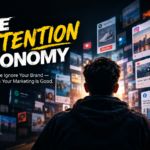
Why People Ignore Your Brand — Even When Your Marketing Is Good
The internet has given every brand a voice, but it has also made it harder for anyone to be heard. Every day, people scroll through hundreds of posts, watch short videos, see advertisements, read notifications, visit websites and move from one platform to another. In the middle of all that noise, your brand gets only a small opportunity to make someone stop and pay attention. You may have an excellent product, a professional website and a carefully planned digital marketing strategy, but none of those things matter if your audience simply scrolls past without noticing you. This is the reality of the attention economy: before you can earn a customer’s trust, interest or money, you first have to earn their attention.
The interesting part is that people are not actually searching for advertisements when they open Instagram, YouTube or another social platform. They are looking for entertainment, information, inspiration, conversations or something that connects with their current situation. That means your brand cannot simply enter the conversation by saying, “Here is our product.” It needs to give people a reason to care. A strong digital marketing strategy starts by understanding what the audience is already thinking about and then creating a message that naturally fits into that attention.
This is why two brands can sell almost the same product but receive completely different responses online. One may constantly talk about its features, prices and offers, while another talks about the problems customers experience and shows how its product fits into their lives. The second brand may not necessarily have a better product. It may simply understand its audience better. Good marketing isn’t only about what a business wants to say. It is about finding the connection between what the business offers and what the audience actually cares about.
Think about how people behave when they are scrolling. They don’t carefully study every post. They make incredibly quick decisions. Something catches their eye, they understand it, and within a moment they decide whether it deserves another few seconds. This is why the opening of a piece of content matters so much. A headline such as “5 Reasons Your Website Isn’t Getting Customers” creates curiosity because it immediately introduces a problem. A statement like “Your website looks good, but can people find it?” creates a question. A strong visual can do the same thing without using many words. The objective isn’t to trick someone into stopping. It is to make the content genuinely relevant enough that stopping feels worthwhile.
That distinction is important because attention without value is temporary. Clickbait can make someone curious once, but if the content doesn’t deliver what the headline promised, trust disappears. The best marketers understand that the first few seconds are not the destination. They are the doorway. Once someone enters, the content needs to reward their attention with something useful, interesting or memorable.
Another reason brands get ignored is that they talk too much about themselves. “We are experts.” “We provide the best service.” “Our company offers premium solutions.” These statements may sound professional, but they don’t necessarily give the customer a reason to care. People naturally pay more attention when they can see themselves in the message. Instead of simply saying that you provide SEO services, you could talk about the frustration of having a beautiful website that nobody discovers through Google. Instead of saying that you offer social media marketing, you could explain why a business can post every day and still struggle to create meaningful engagement. The service hasn’t changed. The story around it has.
This is where audience understanding becomes one of the most valuable skills in digital marketing. Before creating content, a marketer should understand who the content is for. What questions do they ask? What problems do they face? What are they trying to achieve? What makes them hesitate? What kind of language do they naturally use? When a brand understands these things, content stops feeling like advertising and starts feeling like communication.
The attention economy also changes the way businesses should think about content volume. When engagement is low, the first reaction is often to create more. One post becomes three. Three become seven. Eventually, a business is posting every day simply because it feels like it should. But more content doesn’t automatically create more attention. If the message is irrelevant, publishing it more often only produces more irrelevant content. A smaller amount of well-planned content can sometimes communicate more effectively than a constant stream of content without a clear purpose.
The goal should therefore not be to win every scroll. It should be to become memorable to the people who actually matter to the business. A local restaurant doesn’t need everyone on the internet to remember it. It needs the right people in its area to remember it when they’re hungry. A digital marketer doesn’t need every Instagram user to become a client. They need businesses looking for the kind of services they provide to remember their name when the need appears.
This is also why branding and content strategy are closely connected. A brand that consistently communicates in a recognizable way becomes easier to remember. The colours, typography, photography, tone, storytelling and overall personality all contribute to that recognition. Over time, people may not remember a particular post, but they may recognize the style immediately. That recognition can become valuable when the customer is finally ready to make a decision.
Attention also needs somewhere to go. Getting thousands of views is not automatically the same as creating business value. Imagine a video that receives a huge number of views but gives viewers no idea what the brand actually does. It may have generated visibility, but the attention has nowhere to move. Strong digital marketing connects attention with the next step. A social media post can lead to a website. A website can explain a service. A portfolio can demonstrate capability. A contact page can make the next action simple. The journey is connected.
This is why the most useful question isn’t always, “How many people saw this?” A better question can be, “What happened after they saw it?” Did they visit the website? Did they explore another page? Did they save the content? Did they share it? Did they ask a question? Did they remember the brand later? Different content has different objectives, so success should be understood in context.
The attention economy has also made originality more important. The internet is full of repeated ideas. Every day, people see the same marketing advice, the same motivational quotes, the same generic business posts and the same recycled captions. When everything sounds the same, people stop noticing. A unique point of view can therefore become a competitive advantage. You don’t always need to invent something nobody has ever thought about. Sometimes you simply need to explain a familiar problem from an angle people haven’t heard from you before.
For personal brands, this becomes even more powerful. Your experience, perspective and way of explaining things can become part of your content identity. Another person can use the same marketing tools you use, but they cannot completely copy your way of thinking, your experiences or the way you connect ideas. That is why personal branding isn’t simply about putting your photograph on a website. It is about consistently showing people how you think and what you can contribute.
At the end of the day, attention is not something a brand can demand. It is something it has to earn. Your audience doesn’t owe you a few seconds simply because you created an advertisement. You earn those seconds by being relevant, clear, interesting or useful. You keep them by delivering on the promise you made at the beginning. And you turn them into something valuable by creating a genuine connection between the audience and the brand.
The digital world doesn’t necessarily need louder brands. It needs more meaningful ones. A business doesn’t need to speak to everyone. It needs to speak clearly to the people who are most likely to care. Your brand doesn’t win because everyone notices it. It wins when the right people remember it.